Part I covered how liquidity is measured and how automated market makers function in crypto-native markets. The harder question is what happens when those same mechanisms are applied to tokenized real-world assets.
AMMs work best when several conditions exist at the same time: fungibility, continuous external price discovery, fast arbitrage, atomic settlement and access to hedging markets. Individually valued real-world assets rarely offer all of them. That changes the way their tokens should trade and, more importantly, the mechanisms available to keep market prices connected to underlying value.
Asset backing is not the relevant distinction
It is tempting to divide the market into crypto-native tokens on one side and asset-backed tokens on the other, then assume AMMs are naturally suited to the first category. Asset backing, however, tells us very little about whether an AMM will function well.
USDC, tokenized gold and tokenized Treasuries are all backed by assets. Their secondary markets can still behave very differently.
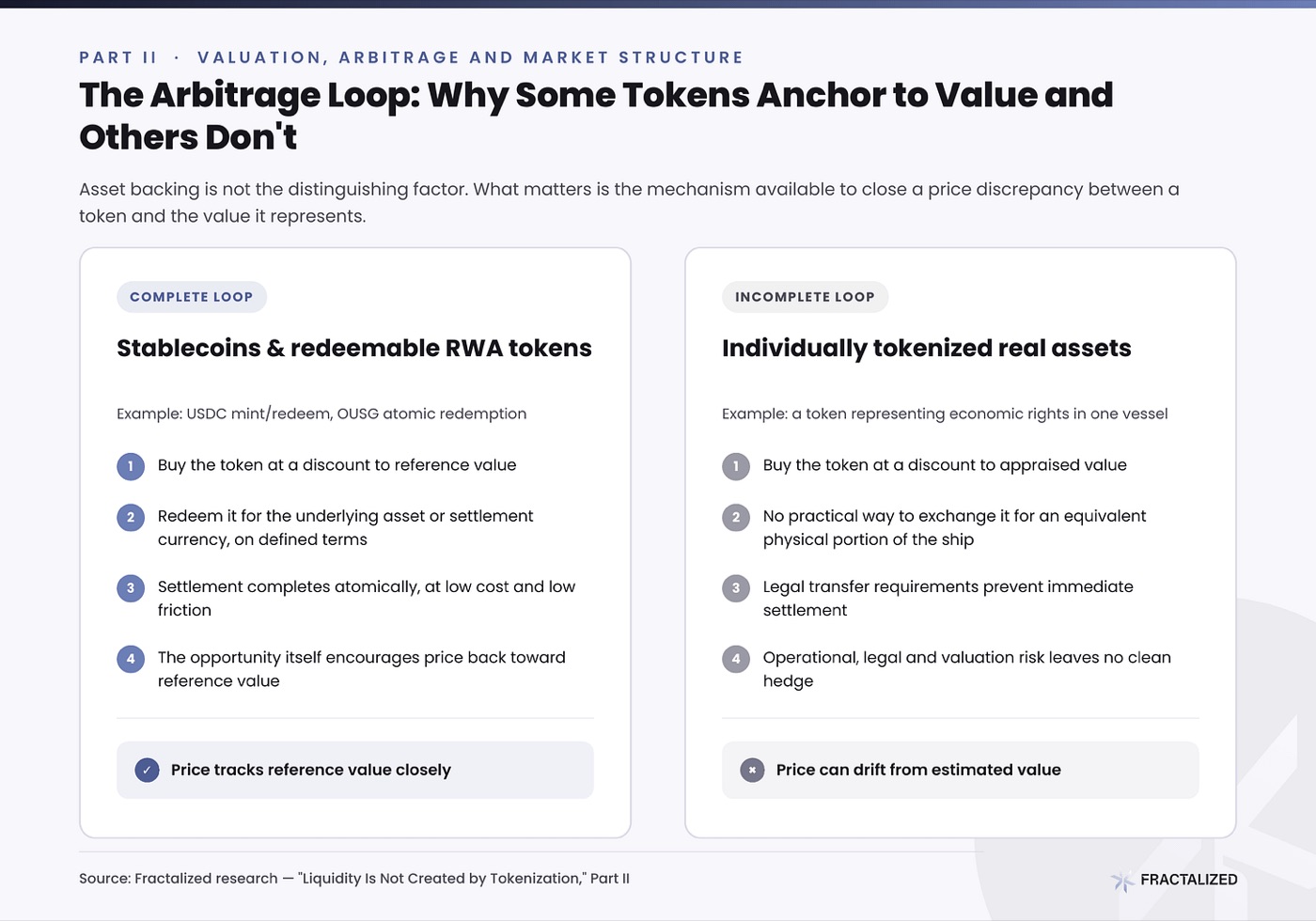
What matters is the mechanism available to close a price discrepancy.
Eligible Circle customers, for example, can mint and redeem USDC against dollars at a fixed 1:1 rate. If USDC falls sufficiently below one dollar, they can buy it and redeem at par. If it rises above par, they can mint new USDC and sell it into the market. The opportunity itself encourages prices back toward the reference value.
Some tokenized Treasury products use a similar structure. Ondo, for instance, describes atomic USDC redemption for eligible OUSG investors, subject to its eligibility requirements and applicable limits.
In both cases, qualified market participants have an executable route between the token and the value it represents. That route, rather than the mere existence of collateral, is what gives arbitrage its force.
Now consider a token representing an economic interest in a single commercial vessel.
Buying the token at a discount does not give an arbitrageur a practical way to exchange it for an equivalent physical portion of the ship, sell that interest at appraisal value and settle the entire transaction immediately. Operational risk, legal transfer requirements, valuation uncertainty and the absence of a clean hedge remain in between.
The vessel may fully back the token. The problem is that there is no equally complete arbitrage loop connecting the market price of that token to the vessel’s estimated value.
That distinction matters.
A valuation is not a standing bid
Publicly traded securities generate prices continuously because buyers and sellers are constantly transacting. A vessel, building, infrastructure project or private loan has no comparable price feed.
Its value has to be estimated.
Depending on the asset, that estimate may draw on comparable transactions, discounted cash flow analysis, replacement cost, contracted income or an appraiser’s view of likely sale proceeds.
For a cash-flow-generating asset, a simplified per-token value would start with the present value of expected net cash flows and residual sale proceeds, subtract debt and other liabilities, and divide the result by the fully diluted token supply.
A vessel valuation would therefore need to account for charter revenue, operating expenses, insurance, dry-docking reserves, expected off-hire, counterparty exposure, renewal risk, debt service, transaction costs, residual value and the time required to complete a sale.
The output is a useful reference, but it remains an estimate.
If an appraiser values a vessel at $15 million, that does not mean a buyer is standing in the market ready to pay $15 million today. Nor does it mean a sale could be completed immediately.
That gap between estimated value and executable value is one of the defining features of liquidity in real-world assets.
The no-arbitrage band
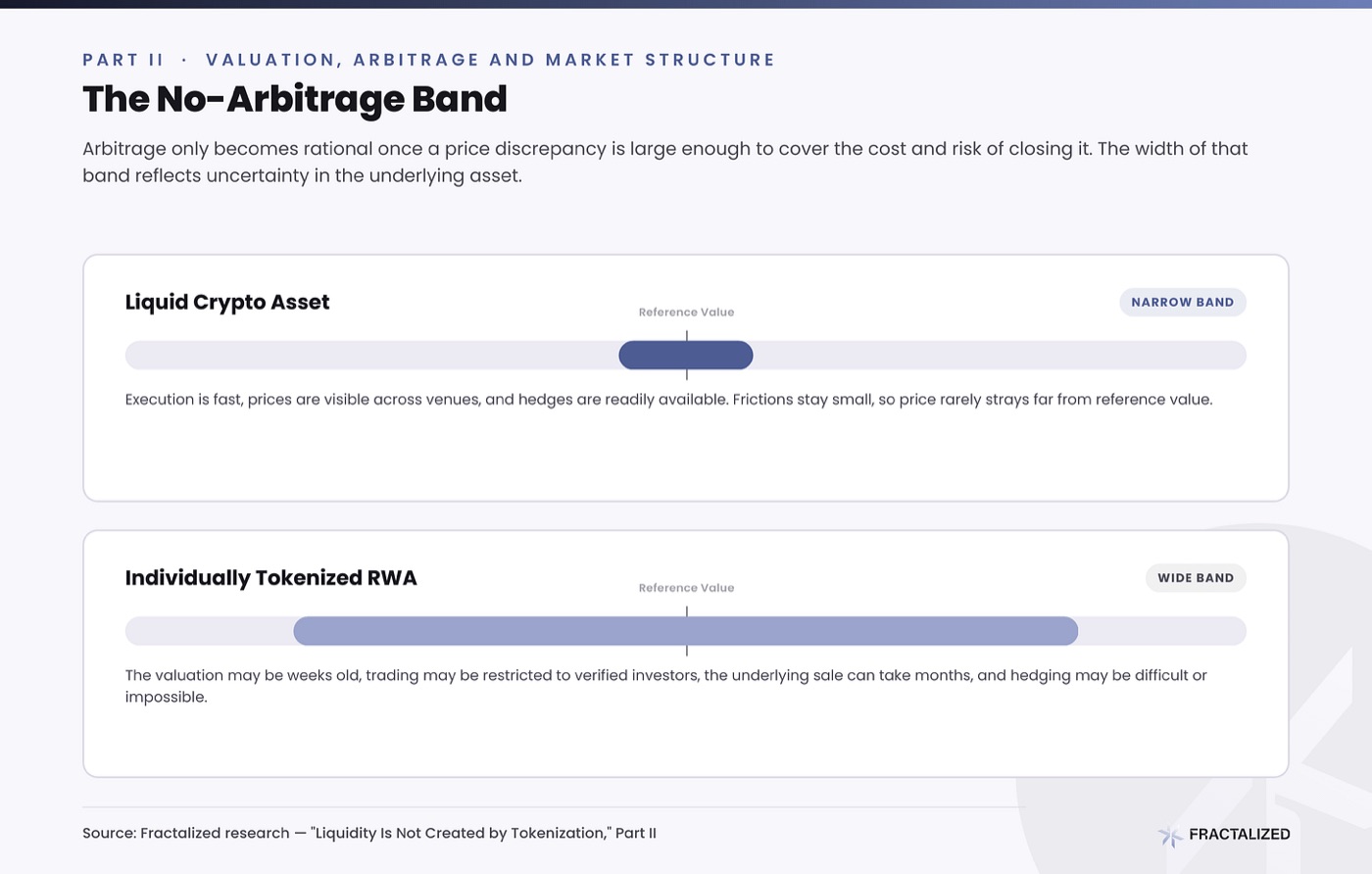
Arbitrage only becomes rational once a price discrepancy is large enough to cover the cost and risk of closing it.
In liquid crypto markets, those frictions can be extremely small. Execution is fast, prices are visible across venues and hedges are often readily available.
An individually tokenized real-world asset presents a different problem. The latest valuation may already be several weeks old. Operational developments can change the economics before a formal revaluation occurs. Trading may be restricted to verified investors, while disposing of the underlying asset itself could take months and require legal or regulatory approvals. Hedging the resulting exposure may be difficult or impossible.
A rational market price can therefore move within a much wider range around estimated net asset value than it would around the peg of a stablecoin.
The width of that range should reflect uncertainty in the asset itself.
A recent appraisal of a contracted, operational asset deserves greater confidence than an older valuation following a material event. Market making needs to account for that difference through spreads, available depth and position limits rather than treating the latest published NAV as a price that must be defended at all times.
The passive pool as a finite reserve
Put a real-world asset token into a passive token-USDC pool and the mechanics initially look familiar.
Buying demand adds USDC to the pool and removes tokens. Selling does the opposite: tokens accumulate while the available USDC reserve falls.
The important difference appears when selling persists.
A constant-product curve can keep adjusting the quoted price, but it cannot create fresh dollars. The smart contract cannot liquidate a building, vessel or loan to replenish its reserves. Once enough USDC has been withdrawn, the pool is simply working through a finite balance sheet.
This is where tokenization can create the appearance of more liquidity than the underlying asset can actually support.
Trading may be available around the clock even though converting the underlying asset into cash takes weeks or months. The Financial Stability Board has warned that tokenization can create or amplify this mismatch and give investors an inaccurate impression of available exit capacity. The Bank for International Settlements has raised a related issue: instant trading and settlement often depend on substantial pre-funded liquidity, particularly when investors eventually want to move back into the non-tokenized financial system.
Liquidity pools can still play a useful role in real-world asset markets. They should simply be understood for what they are: finite, managed liquidity facilities rather than automatic redemption mechanisms at NAV.
Why heterogeneous assets warrant individual tokenization
A chemical tanker and an apartment building may both qualify as real-world assets, but economically they have very little in common. The same applies when comparing either of them with a renewable-energy project or a private-credit facility.
Their cash flows, liabilities, counterparties, operating risks, recovery processes and valuation methods are different. Those differences become harder to see when unrelated assets are folded into a single token or undifferentiated liquidity structure.
For heterogeneous assets, the cleaner model is to preserve the connection between the individual asset and its market: one asset, one legal structure, one token, one valuation process and one trading venue.
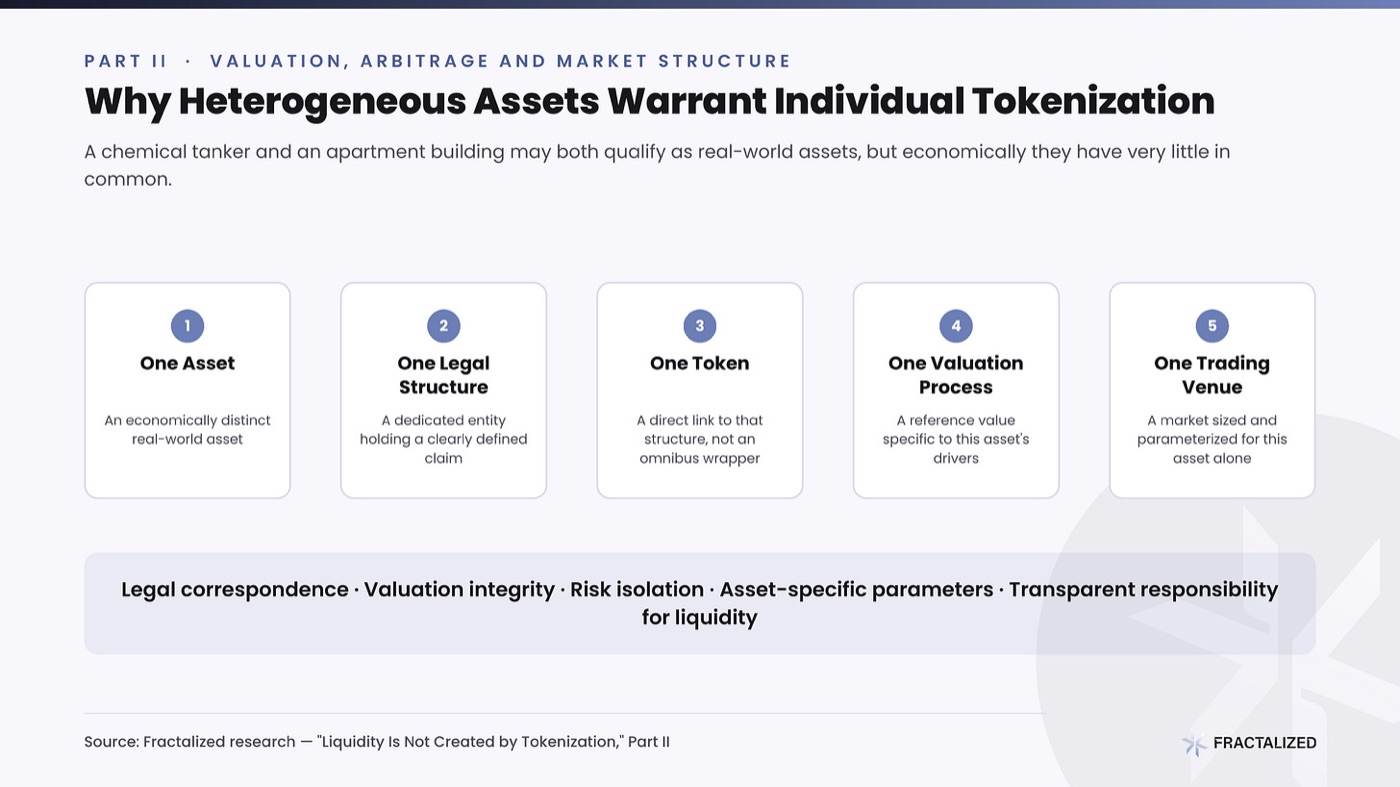
The legal claim comes first. Investors should be able to identify the entity holding the asset, the rights attached to the token, liabilities that rank ahead of token holders, the treatment of operating income and the process following default, sale or insolvency. IOSCO has highlighted the risk that holders of non-native tokens may not fully understand their rights to the underlying asset or the legal consequences of ownership and transfer. A dedicated special-purpose vehicle creates a much clearer chain of correspondence than an omnibus structure whose backing changes over time.
Valuation creates another reason to keep markets separate. A vessel is priced around charter economics, operating condition and residual value. A private loan depends more heavily on borrower quality, covenants, payment performance and expected recovery. Blending them into one market removes information that investors may actually want to see.
An individually traded token can develop its own premium or discount to reference value. That discount might reveal skepticism about an appraisal, concern about a counterparty, weak secondary demand or anticipated capital expenditure. In a pooled structure, much of that signal disappears into the portfolio price.
Liquidity itself introduces a further problem. If unrelated assets draw on the same pool of capital, deterioration in one can affect the others. A well-informed trader may sell the weaker asset into the shared pool and withdraw USDC or stronger assets in return. The liquidity reserve then becomes a mechanism for transferring losses from one market to another.
Separate markets contain that adverse selection.
They also allow the trading parameters to reflect the asset. Fees, spreads, quote reserves, order-size limits, inventory limits, revaluation schedules, circuit breakers and compliance requirements should not be identical for a recently appraised contracted infrastructure asset and a distressed private loan.
Perhaps most importantly, separation makes the cost of liquidity visible. Investors can see whether quote capital is being provided by the seller, the protocol, transaction fees, professional market makers or some other disclosed mechanism. Losses in one market no longer disappear inside the economics of an unrelated portfolio.
Where pooling remains appropriate
None of this means every underlying asset must always be exposed to investors individually.
Pooling makes sense when the collective exposure is the product itself. A diversified fund, a portfolio of standardized loans, fungible warehouse receipts of the same grade, a single bond issuance, a managed Treasury portfolio or an index all fit that description.
Investors in these products are intentionally buying the portfolio rather than a specific asset inside it.
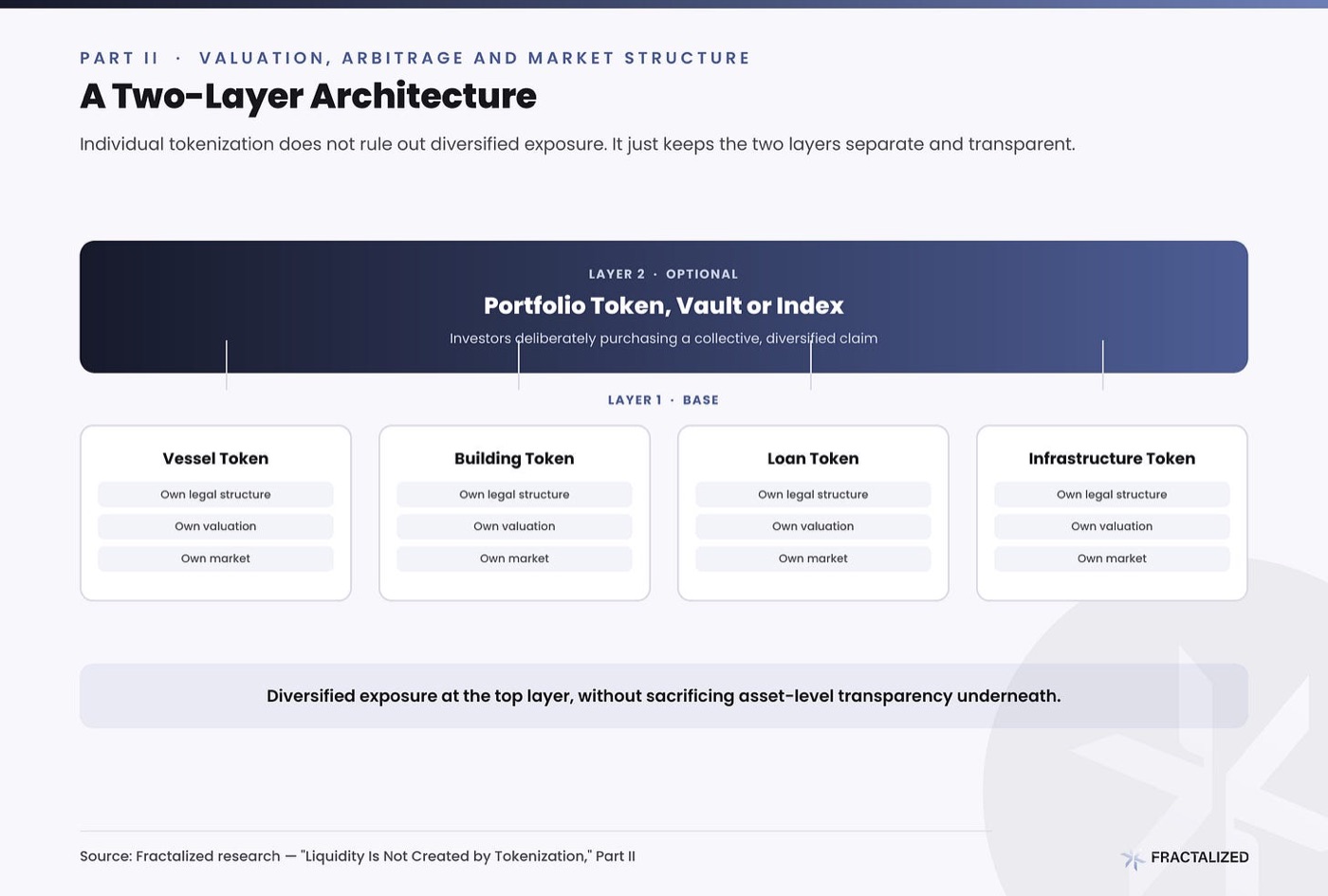
A useful distinction is therefore whether the underlying positions are supposed to be economically interchangeable, or whether investors are deliberately purchasing a collective claim.
That leaves room for a two-layer architecture.
Individual assets can retain their own legal structures, valuations and secondary markets at the base layer. Portfolio tokens, vaults or indexes can then sit above them, allowing investors to buy diversified exposure without sacrificing asset-level transparency underneath.
Fragmentation and shared infrastructure
Keeping markets separate improves risk isolation, but it also consumes more liquidity capital.
If 100 assets each require a dedicated $1 million USDC reserve, supporting them independently requires $100 million of quote capital. A pooled reserve could use that capital more efficiently, but only by allowing the liquidity needs of one asset to affect the resources available to another.
The practical compromise is to share infrastructure without erasing the economic boundaries between markets.
Settlement, compliance, routing, user interfaces, monitoring and market-making technology can all operate across many assets. Liquidity capital can also be managed centrally, provided that its allocation is explicit.
Each asset still needs a minimum reserve, an inventory ceiling, a maximum draw on shared capital and a defined loss budget. Otherwise, a system that appears to consist of separate markets can recreate the same contagion through the back end.
The BIS has warned that fragmented token arrangements can lock liquidity and securities across different platforms. A similar problem can arise inside a single RWA exchange. Shared routing improves capital efficiency only if moving liquidity between markets does not create hidden guarantees between them.
What active market making requires
For a real-world asset, active market making is an operating process rather than a liquidity pool that can be deployed once and left alone.
Valuation, quoting, inventory, rebalancing and emergency controls have to work together.
The starting point should be a reference value with an uncertainty range around it. Confidence in an appraisal naturally declines as it ages, and the range should widen when reporting becomes incomplete, market volatility rises or something material changes in the asset’s operations.
A two-week-old appraisal may still be perfectly useful for a stable asset operating under a long-term contract. Its value as a trading reference changes immediately if the asset suffers physical damage, loses a major counterparty or experiences a contract termination.
Quotes should respond to that uncertainty.
The bid sits below estimated fair value and the ask above it, with the gap reflecting execution costs, funding requirements, valuation risk and the market maker’s own inventory. Those parameters cannot remain static when conditions change. Keeping the same liquidity range around an outdated appraisal simply creates an opportunity for better-informed traders.
Inventory matters just as much as valuation.
As sustained selling causes the market maker to accumulate tokens, bids should become cheaper and smaller while offers become more attractive to potential buyers. The spread may need to widen, fees may need to rise and large trades may be better routed through RFQ or block execution rather than pushed through the standing pool.
Eventually, a hard inventory or reserve limit may be reached. At that point, continuing to quote simply for the sake of continuous trading is not necessarily sensible.
Revaluations require similar discipline. A new appraisal should be published together with its effective time before the market is repositioned around it. The reference-price source can then be updated, liquidity ranges moved and spreads, order limits and reserve requirements recalculated.
Leaving the old range active after publishing a new valuation gives informed traders an obvious stale price to trade against.
Material events also need predefined treatment. Physical damage, counterparty default, contract termination, insurance claims, litigation, regulatory action, delayed financial reporting and proposed asset sales can all alter the reliability of the prevailing reference value.
Sometimes the right market-making decision is to widen the market. Sometimes it is to reduce available size. In more serious cases, pausing trading may convey the economic reality more accurately than maintaining the appearance of uninterrupted liquidity.
Yield-bearing assets create one additional complication: distributions affect price.
Suppose a token is about to pay $0.20 per unit. Once the entitlement to that payment has passed to the holder of record, the token’s economic value should fall by roughly the amount distributed, all else equal.
The market therefore needs clear rules covering record dates, snapshot blocks, accrued but unpaid income, cum-distribution and ex-distribution pricing, any wrapping process around the distribution date, and the treatment of tokens sitting inside liquidity pools.
Without that coordination, the trading price and the actual distribution entitlement can diverge in ways that are straightforward to exploit.
A hierarchy of price convergence
Publishing NAV is useful, but publication alone does not force the market to trade anywhere near it.
Price convergence becomes stronger as the connection between the token and the underlying value becomes more executable.
The most robust version is contractual creation and redemption. Qualified participants can exchange tokens for cash or underlying value under predetermined terms, giving arbitrageurs a direct way to enforce the relationship.
Where redemption is unavailable, committed professional market making becomes more important. A well-capitalized market maker can provide two-sided quotes and absorb temporary imbalances, although it is taking balance-sheet risk in doing so.
NAV-informed liquidity management provides another layer. Quotes, liquidity ranges and inventory limits can move as valuations or market-maker positions change.
Natural secondary demand helps as well, but it depends on investors voluntarily stepping in at prevailing prices.
At the other end of the spectrum sits a passive AMM whose only source of liquidity is whatever happens to remain in its reserves. It can execute transactions mechanically, but it has the weakest mechanism for pulling price back toward underlying value.
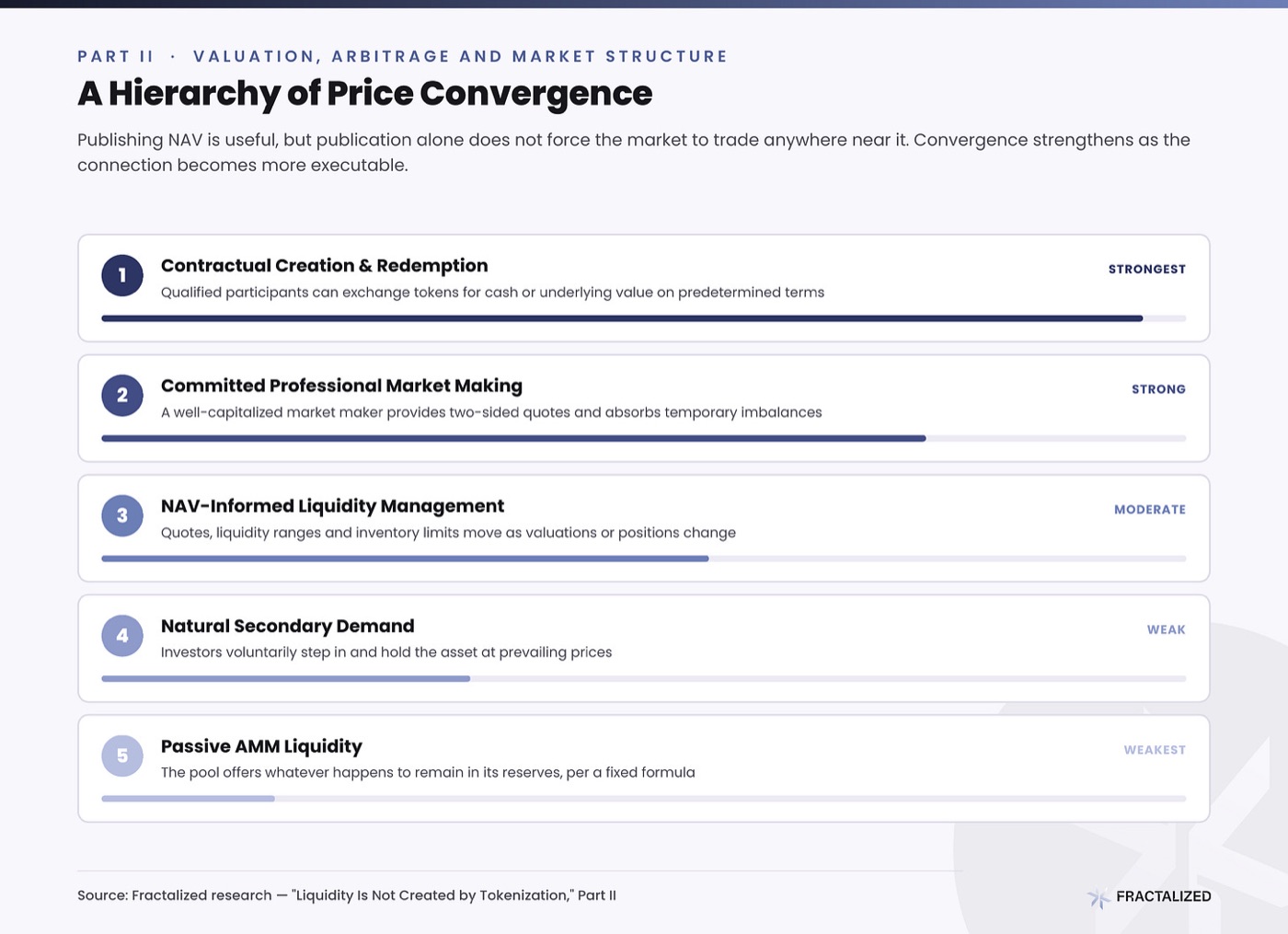
For a unique physical asset, continuous redemption at NAV is usually unrealistic. That makes the middle of this spectrum particularly important: transparent valuation, professional quote capital and active inventory management.
Part III examines a published architecture built around that combination.